Internal combustion engines power billions of vehicles worldwide, yet many people don’t fully understand how they work. In this post, a Silver Youth STEMM Award participant explores the science behind ICEs, from combustion to emissions.
Approximately 1 billion cars around the world use petrol and diesel, and despite drastic changes in engine technology, the principles of an internal combustion engine have remained the same for over a century.
How does an internal combustion engine work?
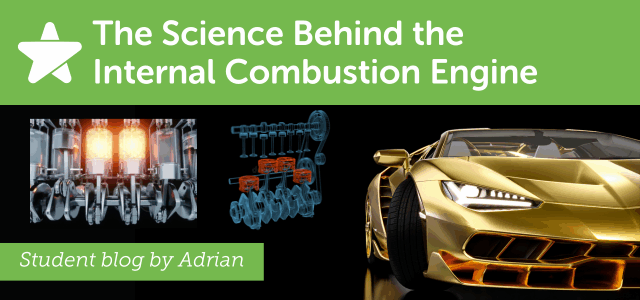
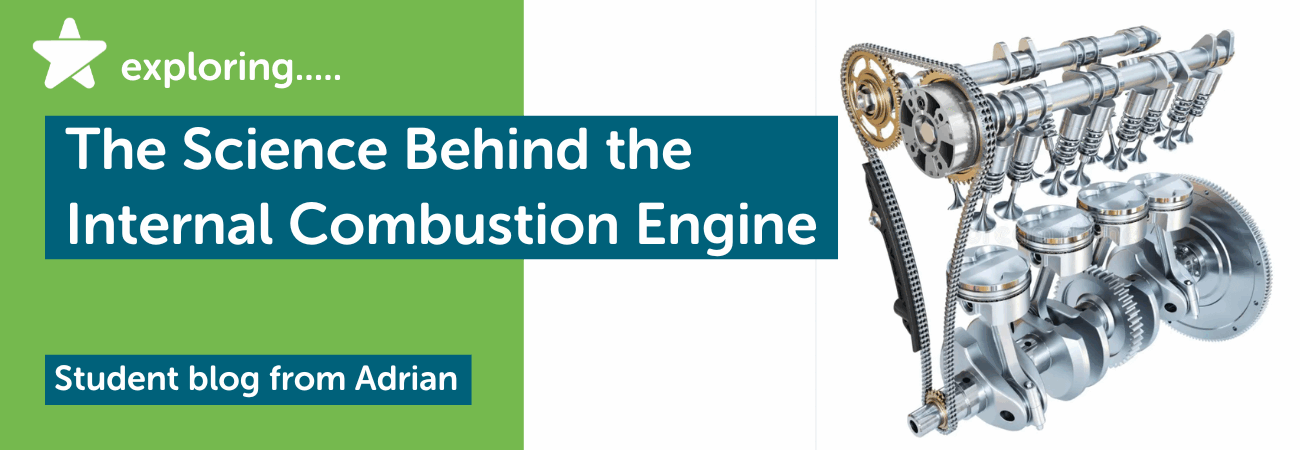
Most ICE (Internal Combustion Engine) cars rely on a 4-stroke engine to produce the power needed to make them move. The majority of these cars use a piston system. The engine has cylinders which hold a small piston each, connected to a crankshaft that converts the pistons’ vertical movement into rotational movement, helping the pistons glide up and down the chamber. The crankshaft’s rotation drives the four strokes, while the camshaft controls the opening and closing of the valves. As the piston moves down the chamber, a mixture of air and petrol, a mix of hydrocarbons, is sprayed into the open space before being compressed by the piston moving up, heating up the mixture and putting it under great pressure. A spark plug then ignites the mixture of oxygen and fuel at a temperature of over 2500°C, causing an explosion and forcing the piston back with a huge amount of force, before leftover fumes of carbon dioxide and water are pushed out as exhaust by the returning piston. These 4 repeating steps, commonly known as ‘suck’, ‘squeeze’, ‘bang’ and ‘blow’, are the core principles of an internal combustion engine. This process is extremely quick, as each explosion turns the crankshaft, which ultimately powers the car. A Formula One car can reach up to 15000 revolutions per minute, which is approximately 45000 explosions per minute with its V6 engine.
Combustion, air–fuel ratios and efficiency
While the engine’s processes may seem simple, what can make or break an engine is its air-fuel ratio. A car’s AFR is always different, but the ideal reaction is 2C8H18 + 25O2, known as a stoichiometric mixture. For petrol engines, this corresponds to an air-fuel ratio of about 14.7:1 by mass. The car’s ECU, essentially its computer, is designed to maintain timing of ignition as well as manipulate your air-fuel mixture ratio to ensure complete combustion and maximum efficiency. Deviate from this balance, and the results speak for themselves. Too lean of a mixture means too much air, which can cause internal temperature to skyrocket. Too rich of a mixture means too much fuel, which leaves wasted hydrocarbons and a less efficient engine.
Deflagration vs detonation
However, the word “bang” is a misnomer. It implies the combustion is a single, instantaneous explosion. A properly functioning engine relies on deflagration: a subsonic wave of fire that spreads rapidly but orderly through the compressed air-fuel mixture. The spark plug ignites an extremely small flame, which grows and propagates outward, pushing the piston down with a smooth, controlled rise in pressure. This is a controlled burn, not a bomb. The antagonist of this smooth process is detonation, commonly known as engine knock. It is a supersonic shockwave, an uncontrolled auto-ignition of the remaining fuel-air mixture (end-gas) that occurs after the spark plug has already started the main flame front. Instead of a pushing force, you get a hammer-like shockwave that rattles the pistons and can lead to catastrophic engine damage, such as blown pistons and damaged engine blocks.
Emissions and environmental impact
Despite its incredible power and beautiful sound, the ICE has many problems. The most glaring problem is its emissions. After combustion, waste gases such as carbon monoxide, unburnt hydrocarbons and carbon dioxide are produced as a product. These have a negative effect on the environment, as they contribute to global warming. Nitrogen oxides, which can produce acid rain, are also produced during combustion. As a result, most cars have a catalytic converter. A small box made up of a ceramic honeycomb structure and metal fillings of palladium or platinum. When the car is hot enough, around 400°C, the catalytic converter reacts with the waste gases produced from the engine, oxidising products such as CO to produce CO₂, as well as reacting nitrogen oxides with carbon to reduce the emissions released by the vehicle. However, despite these attempts at making ICE cars safer for the environment, there is no debate that unless significant changes in fuels are made, ICE cars will always be bad for the environment due to the emissions they produce, with up to 18% of the EU’s entire CO₂ emissions in 2019 due to road transportation vehicles [1]. However, that is beginning to change. With car corporations such as Toyota and Porsche leading the charge to hydrogen fuels, rather than releasing harmful gases into the atmosphere, the exhaust produced from hydrogen fuels is simply water. So in the near future, it is possible we may be able to see combustion engines in a cleaner, more environmentally friendly way.
Sources:
https://edu.rsc.org/everyday-chemistry/how-car-engines-work/4015995.article
https://www.epa.gov/greenvehicles/greenhouse-gas-emissions-typical-passenger-vehicle
 Adrian is a Year 12 student studying in England and is currently completing his Silver Youth STEMM Award. His main interests are chemistry, engineering, and hands-on practical work.