What lies at the very deepest point of our planet? In this post, Youth STEMM Award participant Will explores the Mariana Trench, uncovering its geology, marine life and the human impact reaching even the ocean’s greatest depths.
The Mariana Trench, the deepest and most mysterious part of the ocean, is one of the most unique places on the planet. Most people recognise this but know very little about it. It is home to some of the most unique life on Earth and some of the most extreme environments. Despite this, most people don’t know very much about it. So, what is the trench like? And what is down there?
The Trench
The Mariana Trench is situated 2,225km east of the Philippines. It is around 2,550 km long, approximately 69 km wide and reaches depths of approximately 11 km. It is thought to be around 180 million years old. The deepest point is referred to as Challenger Deep and is in the Southern part of the Trench. The tip of Mount Everest is about 2 km closer to sea level than the bottom of the trench. The pressure exerted from water above the trench is over 1,000 times stronger than standard atmospheric pressure. It is roughly 1-4°C but the hydrothermal vents release water at around 370°C. In 2009 it was designated a US National Monument by President George W. Bush. The trench was named after the nearby island the Marianas, which was named in honour of a Spanish queen in the 1600’s called Mariana of Austria.
The Geology
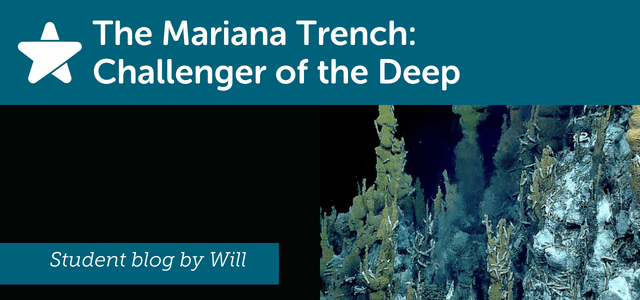
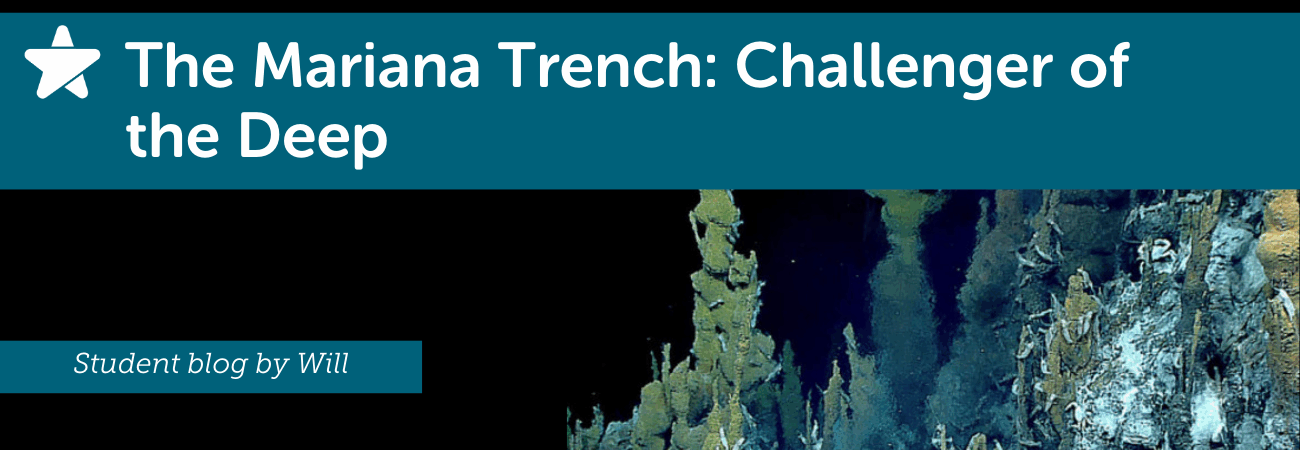
The Mariana trench is formed because of the Pacific Plate sliding under the Mariana Plate for over 50 million years. This places it on the ring of fire and in a hot spot for geological events. It experiences earthquakes and cold seeps while containing volcanoes, hydrothermal vents and pools of molten sulphur. These extreme and volatile environments harbour some of the most unique communities of organisms which live in the most high-pressure fluid composition recorded in any ocean. The Mariana accumulates many different types of rocks such as ultramafic and cumulate gabbroic or volcanic rocks like basaltic and dacitic.
The Marine Life
This area is home to many extremophiles, organisms that live under extreme environments, including high pressure or high temperature, such as the Mariana snailfish which has a high concentration of organic molecules called piezolytes that prevent their cellular membranes and proteins from being crushed by the immense pressure. Also because of the depth no sunlight reaches far enough down for plants to survive meaning that life must find a different way to survive. Another organism often associated with deep-sea hydrothermal vents is the 2-meter-long giant tube worm. It survives from the symbiotic bacteria that oxidise sulphur into nutrients.
However, these vents also contain predators such as the Yeti Crab (Kiwa Hirsuta), a deep-sea crustacean found near hydrothermal vents. These crabs must live close enough to the vents that they don’t die of hypothermia while not too close that the geothermal heat fries them. There claws are covered in blond hairs called setae which using the oxygen, methane and hydrogen sulphide from the vents allow for bacteria to grow. So, if they are unable to kill a tube worm before it retracts its gills, they have a consistent food source.
The life found at the bottom of the ocean is not only small creatures. One of the largest predators to inhabit deep ocean environments is the goblin shark. Goblin sharks are thought to have lineage going back 125 million years ago. Their name comes from the Japanese tenguzame, the tengu being a mythical creature with a long nose and red face. The most recognisable parts of the goblin shark are the long flat snout and protruding teeth. Despite the hydrodynamic appearance it is quite sluggish hunting cephalopods (e.g. octopus, squid, cuttlefish) and crustaceans (e.g. crabs, lobsters, shrimp) which are slower than the shark.
Pollutants
Sadly, during 2016 while an expedition was looking into the chemical structure of the crabs that live in the trench they found high levels of PCBs, toxic chemicals which were made illegal in the 1970s for the damage it did to the environment. More researchers found that 100% of the amphipods, small crustaceans that can withstand roughly every condition on earth, contained at least 1 piece of manmade material in their stomachs. Just 3 years later, Victor Vescovo, an underwater explorer, reported to have seen a plastic bag and sweet wrappers. There have been talks over the years about using deep sea trenches as nuclear waste disposal sites but fortunately this has been made illegal due to unpredictability of large earthquakes which could cause more harm with the extra nuclear waste.
References:
The Trench: https://en.wikipedia.org/wiki/Mariana_Trench#
https://whatsinaname.hmnh.harvard.edu/yeti-crab
https://www.mbari.org/animal/giant-tubeworm/
https://en.wikipedia.org/wiki/Goblin_shark#
Pollutants: https://en.wikipedia.org/wiki/Victor_Vescovo
 Will is a Year 11 pupil currently working towards their Silver Youth STEMM Award. He enjoys Biology, Chemistry and Maths, and hopes to work as a marine biologist.