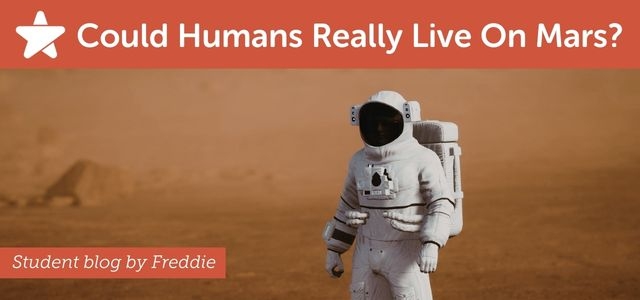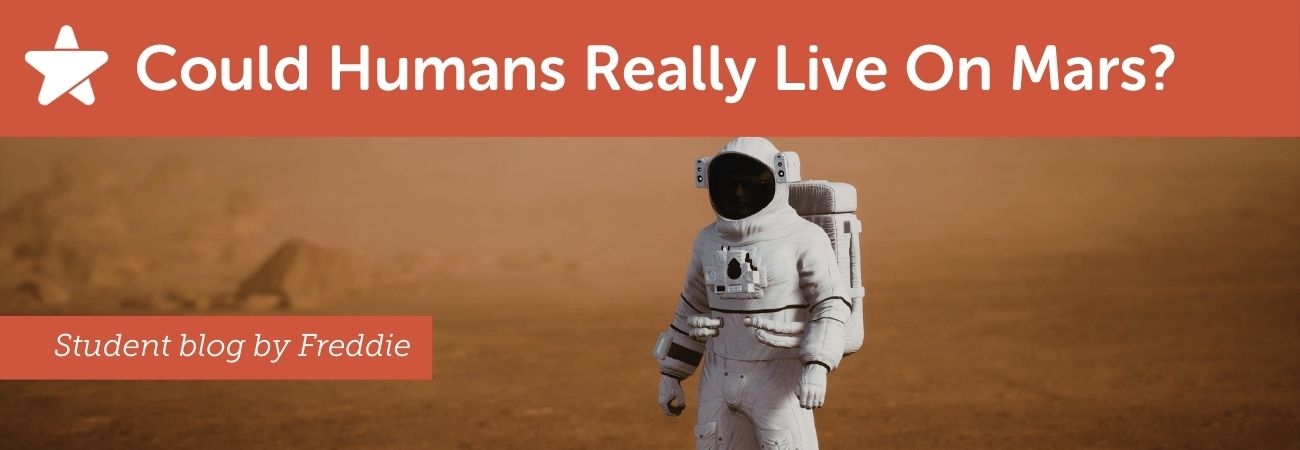
Could humans one day call Mars home? In this post, Youth STEMM Award participant Freddie, explores why the Red Planet is considered our best chance of living beyond Earth, and the challenges we would need to overcome to make it possible.
For as long as we’ve stared up at the night sky, we’ve wondered what it might be like to live on another planet. Among all the planets in our solar system, Mars has always stood out in our imagination the most. With its enormous volcanoes and iconic red surface, it feels like the closest thing we have to a second home. But the big question remains, could humans actually live on Mars?
Why Mars?
Mars is often described as Earth’s “little brother.” It has days only slightly longer than ours, seasons like we do, polar ice caps, and evidence that water once flowed across its surface. Compared to other planets, it’s considered the most practical destination for future human exploration. Venus is a boiling acid-filled sauna, Jupiter has no solid surface at all, and the outer planets are far too cold and distant. Mars is the best candidate if humanity ever wants a second home (although it still takes nine months to reach with current technology).
The Challenges of Martian Living
Living on Mars would be a bit like moving to the most extreme, remote desert on Earth, but with almost no air, freezing temperatures, higher radiation, and giant red dust storms.
Here are the main obstacles we’d face:
- The lack of an Atmosphere.
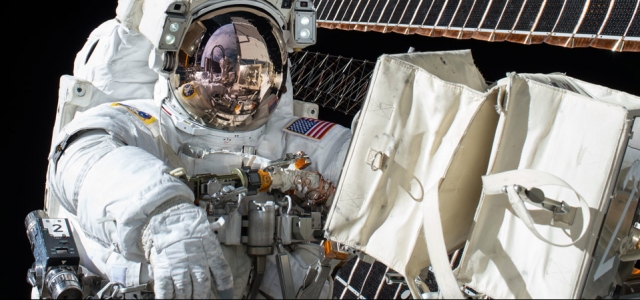
Mars’ atmosphere is 95% carbon dioxide and extremely thin, less than 1% the pressure of Earth’s atmosphere. Humans obviously can’t breathe carbon dioxide, and the lack of pressure would make unprotected survival impossible. Any future inhabitants would need airtight habitats, suits, and oxygen systems like what astronauts wear on the moon.
- Freezing Temperatures
Temperatures on Mars average around –63°C, much colder than anywhere on Earth. Any home on Mars would need advanced insulation and heating systems.
- Dangerous Radiation
Mars has no global magnetic field and a very thin atmosphere, meaning cosmic rays and solar radiation constantly bombard the surface. To stay safe, inhabitants would likely need to build bunkers underground or use thick layers of Martian soil on top of structures as shielding.
- Water and Food
Mars does have ice, especially near its poles and underground. While this could be melted and purified, growing food is harder. The soil contains toxic chemicals, and the environment is dry and frigid. Greenhouses, much like the ones we see on Earth today, would need to be installed with hydroponics and controlled lighting for Martian farms.
How Would We Survive?
Despite the challenges, none are impossible.
We already have the beginnings of technology that could make Mars liveable:
- Pressurised habitats: airtight living spaces capable of holding warmth and oxygen.
- Life-support systems: machines that recycle air and water.
- Hydroponic farming: growing plants without soil, using nutrient-rich water.
NASA, ESA, and companies like SpaceX are already working on prototypes and running simulations to test these systems.
What Would Life Be Like?
Life on Mars would be strange but fascinating. Gravity is only 38% of Earth’s, so you could jump nearly three times higher. Martian days are 24.6 hours, similar enough to Earth’s that your sleep cycle wouldn’t suffer too much. But communication with Earth could take up to 22 minutes, making Mars feel incredibly isolated. For future scientists and explorers, this might be part of the excitement.
Could We Do It?
It won’t be simple, but the dream of life on the ‘Red Planet’ is more realistic than ever. Mars may be cold, dusty, and harsh, but it’s also full of possibility, waiting for us to take the next giant leap.
Sources:
- NASA – Mars Exploration Programme
- NASA – Human Exploration of Mars
- ESA – ExoMars Programme
- National Geographic
- NASA Jet Propulsion Laboratory
 Freddie is a Year 9 student from Essex who recently completed his Bronze Youth STEMM Award, supported by the Jack Petchey Foundation. He hopes to become an entrepreneur in the software development industry and dreams of visiting space one day.