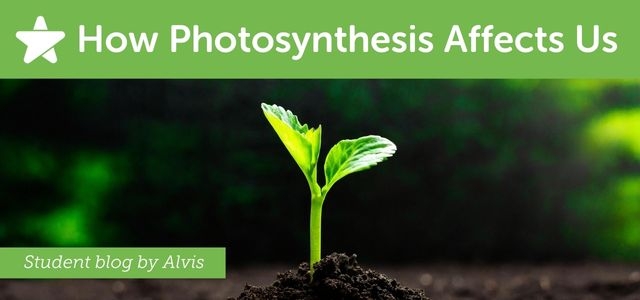
Photosynthesis is one of the most important processes on Earth, supporting life and helping shape our planet. In this post, Youth STEMM Award participant Alvis, explores how photosynthesis works and what it could teach us about future energy solutions.
From the tiny patch of grass in your backyard and cyanobacteria floating in freshwater ponds, to the tallest living tree Hyperion at 116.07 metres, photosynthesis acts as the key mechanism for the survival and thriving of plants and some bacteria to produce their food. But how exactly does it work and what can we learn from it?
The discovery of photosynthesis
Going back to the 1600s, the Belgian scientist Jan Baptista van Helmont planted a willow tree in a pot for 5 years and watered it regularly, alongside noticing there was no change in the mass of soil. He realised that plants somehow gained their mass from the water absorbed, but not from the soil directly, concluding elusively, unresolved. Enter Joseph Priestley, who curiously placed a candle into a closed jar where the flame went out (depletion of oxygen due to combustion) which was restored with an innocent-looking plant (carbon dioxide conversion into oxygen).
More than a century later, the Dutch physician loyal to the Austrian empress, Jan Ingenhousz made clear that a plant with the aid of the light, purifies the ‘bad air’ of a room filled with carbon dioxide by ‘correcting’ it into oxygen. This soon gave rise to the rudimentary, basic idea of photosynthesis where: carbon dioxide + water -> glucose + oxygen, converting solar energy into chemical energy. The truth slowly unfolds.

The complex mechanism
Photosynthesis is down to the cooperation of many components within a chloroplast. It begins at photosystem II, where a photon of sunlight (a packet of energy in the form of visible light) hits the antenna complex of an array of many chlorophyll molecules. These chlorophyll then transfer the energy sequentially to a special pair of chlorophyll, which is excited where electrons gain enough energy to leave. Water, as a reactant, is split into oxygen, protons and electrons, where the electrons produced replenish the pair of chlorophyll to continue the reaction. The electrons are funnelled into a long winding path of electron carriers along the electron transport chain: plastoquinol, cytochrome b6f, plastocyanin, as intermediate stops before reaching photosystem I which will eventually reduce NADP+ into NADPH.
Nature is clever and intelligent, producing oxygen in the process which is released into the air for other organisms to respire. Simultaneously, the protons aren’t wasted, but instead its energy is harnessed through a chemiosmotic gradient to drive the synthesis of ATP. ATP and NADPH work in tandem behind the scenes, in the light-independent Calvin cycle to produce sugars used by the plant for growth. The Calvin cycle welcomes carbon dioxide, producing other intermediary products as it reacts, a perpetual cycle that fixes inorganic carbon dioxide into organic compounds used to make glucose, for the plant’s energy and growth. As an aside, some view this as the ‘dark side’ of photosynthesis as light is not directly needed, yet both the light dependent and independent work seamlessly together to produce great results.
The power of photosynthesis
Not only is this reaction a multifaceted and fascinating chemical process, it is also crucial towards ecosystems and environments. Plants become autotrophic producers, producing their own food which are then consumed by other organisms, transferring biomass and energy along food chains. They are the foundational keystones to support large scale ecosystems – rainforests, savannahs and so on. Moreover, plants are also important carbon sinks, absorbing carbon dioxide to alleviate its effect as a greenhouse gas that contributes to global warming.
Photosynthesis and our future
Within this deceptively simple process in our surrounding green friends, there lies a lot of potential for our future. Some individuals have attempted to directly incorporate photosynthesis into their products. The GoGreenFilter uses a filter filled with algae that is connected to the tube of vehicle exhausts, converting carbon dioxide into oxygen, with its creators reporting a reduction in emissions of 74.25%. This could act as a short term solution to alleviate the enhanced greenhouse effect due to increased greenhouse gas emissions, to halt the destruction that humans are doing to our planet.
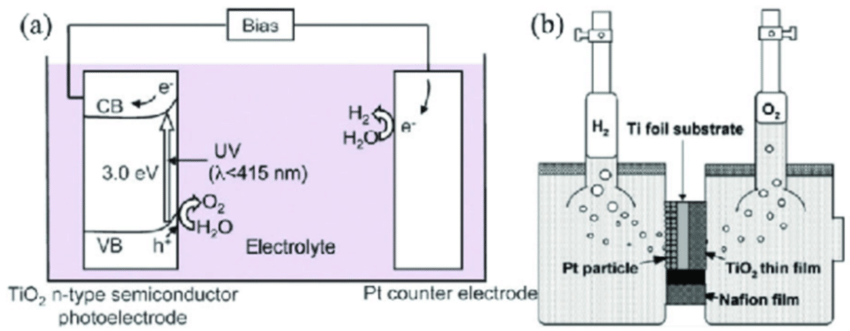
However, we eventually need a long term resolution for our energy crisis, which is heavily reliant on fossil fuels that will run out very soon. In 1972, Kenichi Honda and Akira Fujishima, in the University of Tokyo, discovered the amazing effect of titanium dioxide upon UV rays – photocatalytic water splitting. The UV rays provide energy which excites the electrons in the valence band (VB, a lower-energy band) into the conduction band (CB, a higher energy band). This forms a positively charged hole, oxidising water to produce oxygen:
2H2O + 4 holes of the valence band -> O2 + 4H+
Negatively charged electrons flowing to the opposite electrode, reducing hydrogen ions into hydrogen:
4H+ + 4e– -> 2H2.
The hydrogen gas could then be collected and used as fuel, undergoing combustion with oxygen to release energy for our uses, whilst not wreaking havoc unlike fossil fuels that release carbon dioxide that enhance the greenhouse effect.
This also revolutionises the way we produce hydrogen currently – using methane and steam (water as gas) at very high temperatures and pressures with a nickel catalyst:
CH4 (g) + H2O (g) -> 3H2 (g) + CO (g)
Methane is a hydrocarbon and the main component of natural gas, which is a finite fossil fuel that will run out. Contrastingly, the water used for photocatalysis will not.
However, photocatalysis may not be a highly economical process as only the UV spectrum of incoming sunlight can be utilised, being less efficient than what real plants do with visible light that comprises a large proportion of incoming sunlight unlike UV. Nevertheless, humanity will figure out better solutions in the future, in the face of our contemporary crisis where fossil fuels will deplete and climate change will worsen.
- https://bio.libretexts.org/Bookshelves/Botany/Botany_(Ha_Morrow_and_Algiers)/04%3A_Plant_Physiology_and_Regulation/4.01%3A_Photosynthesis_and_Respiration/4.1.05%3A_The_Light-dependent_Reactions Light Dependent Reactions, Libre Texts of Botany by Melissa Ha, Maria Morrow and Kammy Aliers
- https://www.esalq.usp.br/lepse/imgs/conteudo_thumb/Discovery-of-Photosynthesis.pdf Discovery of Photosynthesis, College of Agriculture, University of São Paulo
- https://www.chm.bris.ac.uk/motm/chlorophyll/chlorophyll_jm.htm Properties of chlorophyll, University of Bristol
- http://solar.iphy.ac.cn/en_first.php?id=1705 Photocatalytic water splitting by the Solar Energy Materials and Devices Group of Renewable Energy Laboratory
- https://www.u-tokyo.ac.jp/focus/en/features/f_00057.html The world of titanium dioxide by the Graduate School of Engineering / Faculty of Engineering University of Tokyo
- What is hydrogen? | National Grid What is hydrogen?, an article by the National Grid
- GoGreen Filter – Revolutionizing Emission Control The website of GoGreen Filter, the enterprise which built the exhaust filter.
 Alvis is a year 11 student from Kent who is interested in Biology and Chemistry.