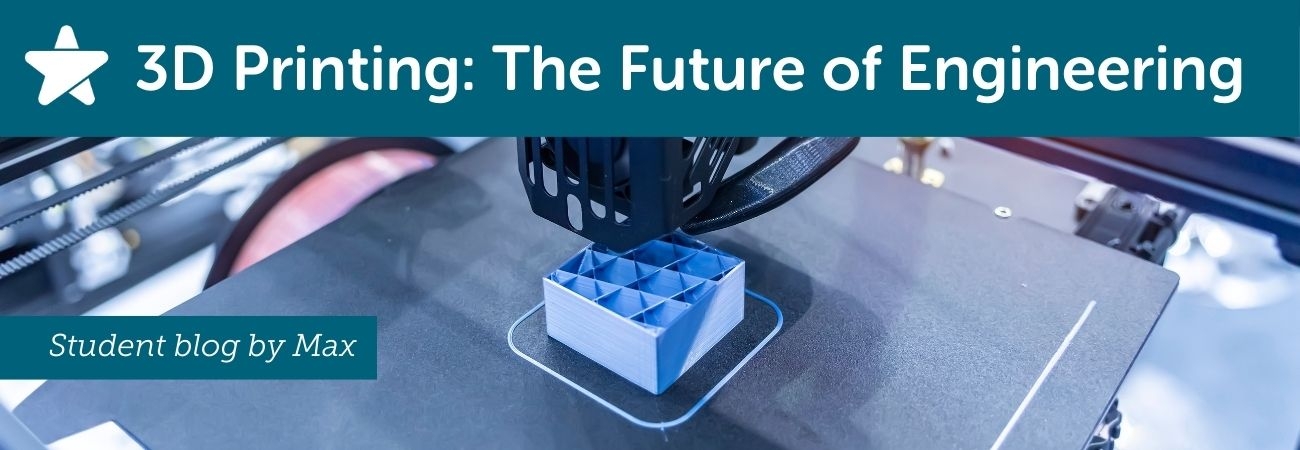
From rapid prototyping to 3D-printed homes, 3D printing is changing the way we design and manufacture products. In this post, Youth STEMM Award participant Max explores how the technology works and whether it could be the future of engineering.
In the last 10 years, 3D printing has become a very prominent manufacturing method and its usage only seems to be increasing. Due to it no longer being considered a ‘new idea’ and production costs decreasing, it is becoming more accessible to manufacturers.
What is 3D printing?
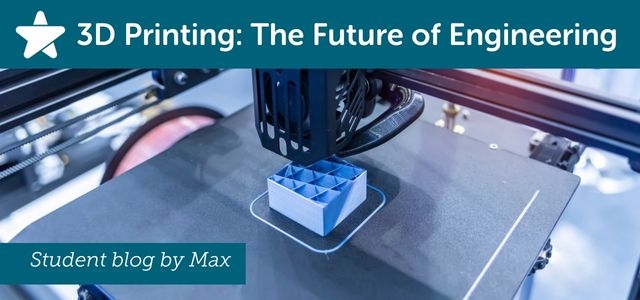
Three-dimensional printing is a subsection of additive manufacturing, the process of creating an object by building it up a layer at a time, though these terms are often used interchangeably. It was first used in an experiment by Dr. Hideo Kodama in 1981. He used photosensitive resin and a layer-by-layer approach to create three-dimensional models.
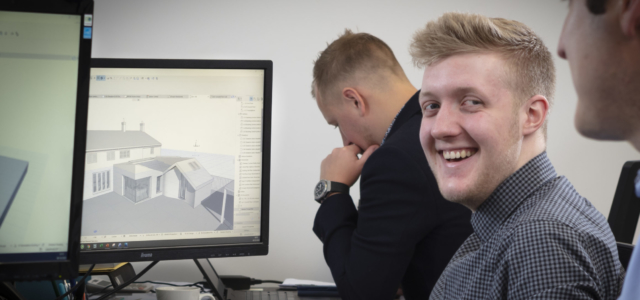
It uses Computer-Aided Design (CAD) to create objects layer by layer. It is used mostly in manufacturing and automotive industries. CAD is a way to digitally create 2D and 3D models before they have been manufactured.
CAD is very useful as it allows you to visualise models and even run simulations on them. It also allows you to easily edit them. It is also very time-efficient, allowing companies to reduce the time it takes for products to reach the market. These CAD files can also be integrated directly into the machines which manufacture the products, allowing a much smoother and more efficient system. It is also highly accurate, meaning that very few mistakes will be made.
With its accuracy, efficiency and convenience, it is no wonder 3D printing is thought to be the future of engineering.
Why are 3D printers so important?
The reasons they are so effective come down to three main factors:
- Speed: 3D printing can significantly speed up normal R&D processes.
- Cost: 3D printing can be cheaper than normal R&D processes.
- Versatility: They can fill a role in practically all industries.
How will future technologies affect 3D printing?
As well as the obvious improvements in accessibility and ease of use, one of the main improvements to 3D printing in the future is thought to be the development of larger scale 3D printing and the ability to use more materials. This would open up the opportunity for developments like 3D-printed homes, which could be a ground-breaking innovation in construction, making homes both cheaper and more available. Organ engineering could also allow for a huge leap in medical science allowing doctors to make medicine more personalized making medicines a lot more effective for specific patients. Many more fields could also benefit, allowing all sectors to make huge leaps towards a more effective and efficient future of manufacturing.
Will the usage of 3D printing continue to grow?
In the last 10 years, 3D printing has become a key part of life, with the valuation of the industry growing rapidly. One market estimate valued the industry at $29.29 billion USD in 2025. But will this trend continue with new developments being made constantly? Well, the simple answer is most likely as many believe any future developments in terms of printing will only help further develop the 3D printing industry to make it even more important. It is predicted to reach a valuation of around $134.58 billion USD in 2034.
There are two main reasons for this increase in demand in the future:
Increase in availability: The engineering materials to create 3D printers and to run them will continue to get cheaper as time goes on making it more accessible for companies to use. This has been a limiting factor in the past for 3D printing but over time it is becoming cheaper and that trend is expected to continue.
Increasing ease of use: 3D printing has struggled in the past with domestic use and use by some businesses due to it being complicated to use. However, developments in user-friendly software and advancements in automation could make it easier to use.
So overall, as time goes on and we discover more technology, it is almost certain that 3D printing will accompany us into this new generation of technological advancements and help us make theoretical ideas physical possibilities.
Sources:
- https://builtin.com/3d-printing
- https://www.fortunebusinessinsights.com/industry-reports/3d-printing-market-101902
- https://www.precedenceresearch.com/3d-printing-market
- https://3dprintingindustry.com/news/the-future-of-3d-printing-in-2030-predictions-by-leading-3d-printing-experts-236279/
- https://www.ptc.com/en/technologies/cad
- https://www.xometry.com/resources/3d-printing/future-of-3d-printing/
 Max is a year 12 student from Rutland who is currently taking part in the Bronze award. He enjoys engineering, science and maths and aspires work in engineering.