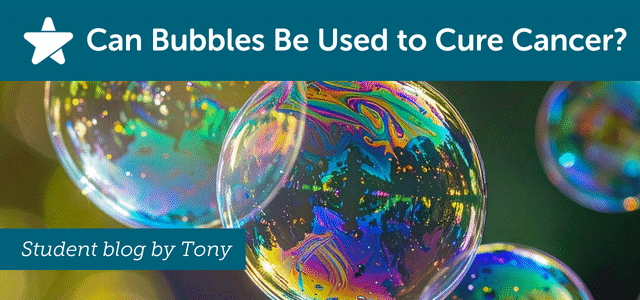
Could tiny bubbles help make cancer treatment more effective? In this post, a Youth STEMM Award participant explores the physics behind bubbles and how researchers are using microbubbles and ultrasound to investigate new ways of delivering cancer drugs.
To answer this question, first we must know what bubbles actually are and the physics behind them.
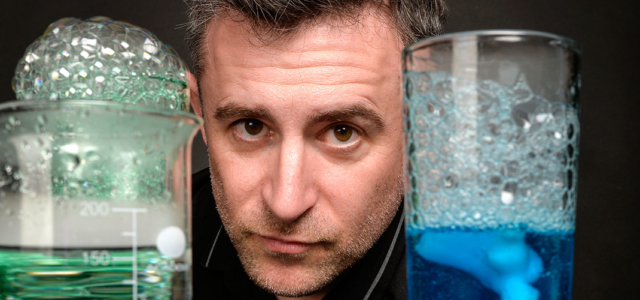
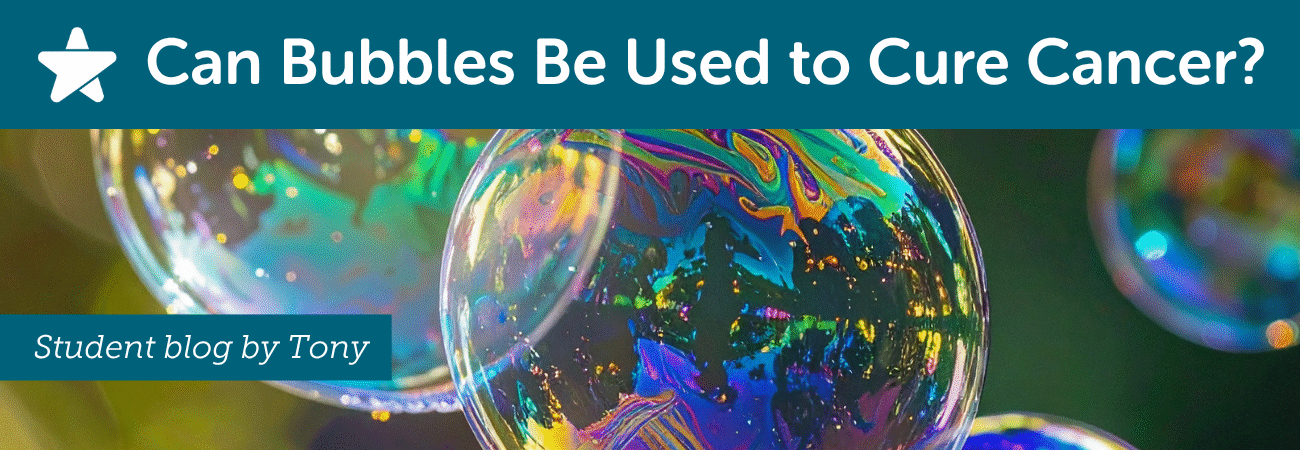
Bubbles are 2 thin films of soap surrounding a thin layer of water which encloses a volume of air (1). They hold together as the surface tension of water tries to pull itself inwards, (which is why water droplets have a dome shape when they’re on a surface) and at the same time, the gas in the bubble collides with the walls and the pressure caused by this balances out the surface tension of the water.
Why can you not get water bubbles?
This is because water has incredibly high surface tension, so a bubble made from pure water would quickly collapse, but if you mix it with soap, you can get bubbles. This is because soap has low surface tension, so if you mix it with water, then the surface tension of the bubble decreases and so the pressure caused by gas can balance out the surface tension which allows the bubble to be stable.
That is quite interesting, but can we use this to cure cancer and how?
While we can’t cure cancer using bubbles, new research on cancer treatment is currently experimenting with using bubbles for drug delivery. Chemotherapy is a very effective tool against cancer, but the delivery of the drugs can be ineffective as not all of the drug actually reaches the tumour (3). This is quite unsettling especially considering the fact that the drugs used can also be harmful to healthy cells, which is why roughly 45% of patients suffered serious adverse effects during chemotherapy (2).
Research has shown that using these microbubbles along with ultrasound can have a 10 times increase in drug penetration to the tumour. The microbubbles range from 0.5µm to 10µm in diameter, which is 10 to 100 times smaller than the width of a human hair (4). Using this technique, they can achieve the same impact on tumour reduction using 40 times less drugs, which is incredible. It also means there is less drugs in your body that can harm your cells.
It would work by injecting a lot of microbubbles into your bloodstream, which can carry the drugs inside of them. Then directing ultrasound where the tumour is, from outside the body. The microbubbles would travel around your bloodstream and when they reach the site of the tumour, the ultrasound would cause them to oscillate and burst, releasing the drugs into the surroundings, which is where the tumour would be located.
The Ultrasound used:
To make the microbubbles burst, the ultrasound used has to have a certain frequency, so that it can effectively make the microbubbles burst and get the drug in the right place. The specific frequency used depends on where the tumour is in the body and how deep it is in the body. The deeper it is, the lower frequency must be used, so that the wave can travel through the body, while lower frequency makes microbubbles oscillate and burst more effectively, it is less precise and so more of the wave can interact with and possibly damage surrounding healthy tissues. Common frequencies used range between 0.3MHz and 3MHz.
The microbubbles:
The microbubbles made must be very stable and small enough so that they can travel through the small blood vessels without bursting. The outside layer used usually consists of polymers, proteins or phospholipids depending on where the tumour is and how deep in the body the microbubbles need to go. The microbubbles have 3 parts to it, the gas core, the shell and the drug that you want to deliver.
Problems with this method:
Ultrasound needs to be high enough to burst the bubbles, but if it’s too high it can damage surrounding tissues.
The collapse of the microbubbles can generate strong forces which can also be damaging in the body, and it is also very difficult to get the bubbles to ‘pop’ in the right place, so it is not as effective as it could be.
Conclusion:
This is a very promising method of using technology to help treat humans. It is still being researched and experimented on by scientists, however, there have already been human trials showing that this could be highly effective.
References:
- https://www.sciencemuseumgroup.org.uk/learning/resources/bubble-fun
- Ingrand I, Defossez G, Lafay-Chebassier C, et al. Serious adverse effects occurring after chemotherapy: A general cancer registry-based incidence survey. Br J Clin Pharmacol. 2020;86:711–722. https://doi.org/10.1111/bcp.14159
- Tilsed CM, Fisher SA, Nowak AK, Lake RA, Lesterhuis WJ. Cancer chemotherapy: insights into cellular and tumor microenvironmental mechanisms of action. Front Oncol. 2022 Jul 29;12:960317. doi: 10.3389/fonc.2022.960317. PMID: 35965519; PMCID: PMC9372369
- Sirsi S, Borden M. Microbubble Compositions, Properties and Biomedical Applications. Bubble Sci Eng Technol. 2009 Nov;1(1-2):3-17. doi: 10.1179/175889709X446507. PMID: 20574549; PMCID: PMC2889676.
Please note: Our blog posts are written by young people taking part in the Youth STEMM Award. They reflect the research, ideas and understanding of the individual author.
 Tony is a sixth form student from Colchester who aims to work in the biophysics/biochemistry industry.