Can you always trust what your eyes are telling you? In this post, Youth STEMM Award participant Jenna, explores the fascinating world of optical illusions and how our brains use predictions, context and experience to make sense of what we see.
Introduction
Our minds don’t see the world how it really is but invent it in their own magical ways.
It feels strange when your mind makes you believe something is true when it’s all a trick. That is why this blog will explain what illusions are and how they work. Optical illusions grab people’s attention because they manipulate the brain’s natural inclination to predict its surroundings. This happens when what we see contradicts what we expect. Our brain’s predictive coding systems then send an “error signal” that draws our attention to the anomaly.
Throughout this blog, I will be explaining what illusions are, the different types of optical illusions, how they work and why people love them so much.
What is an optical illusion?
An optical illusion is something that tricks your eyes into seeing something that isn’t there, or makes you see something different from how it actually is.
They tend to happen when the brain’s “rules” get broken, so the brain takes a guess at what should be there, and that guess is not always correct.
Research shows that illusions can appear through interactions between neurophysiological and psychological processes. Our brains will interpret two – dimensional images as three – dimensional structures. These are usually seen with the assistance of the brain’s natural predictions and it is these predictions that create the illusion.
Illusions have been studied for centuries, from ancient observations to modern science. Today, illusions are used as a form of entertainment or for understanding how vision works, how the brain processes sensory data and how perception can differ from reality.
Types of illusions
Optical illusions come in several different categories; each makes us see different things.
- Literal illusions
These illusions show images that look like one thing but are actually another. One example would be the duck – rabbit drawing, where the same image can be interpreted in two different ways depending on what your brain focuses on.
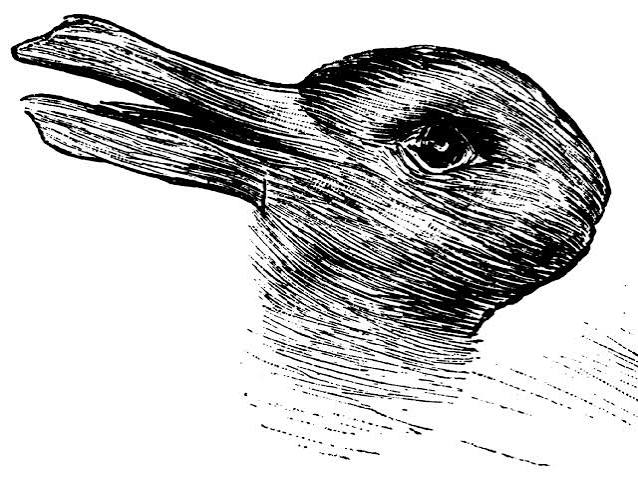
These illusions highlight the fact that perception is flexible – the brain can switch interpretations based on context or suggestion.
- Physiological illusions
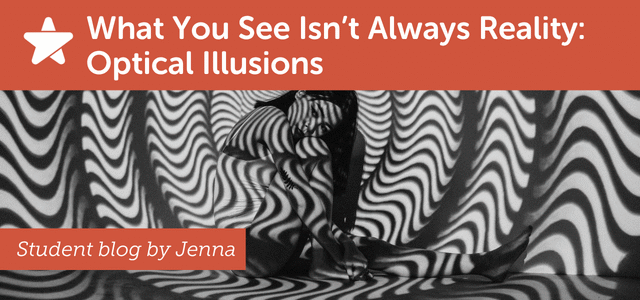
These illusions occur when the eyes are overstimulated by brightness, colour, contrast, or patterns. For example, some circular patterns appear to rotate even though they’re completely still. This occurs because repeated shapes or high‑contrast edges trigger responses that create a false motion.
Neuroscience research shows illusions involving brightness or motion come from interactions between different cortical processing streams in the brain. These streams process different things and sometimes overlap to create optical illusions.
- Cognitive Illusions
These illusions rely on how the brain interprets information. The Müller‑Lyer illusion would be one example: two lines of equal length appear different due to the arrow shapes at the ends. Your brain uses your past experiences and context to judge size, and those cues can be manipulated.
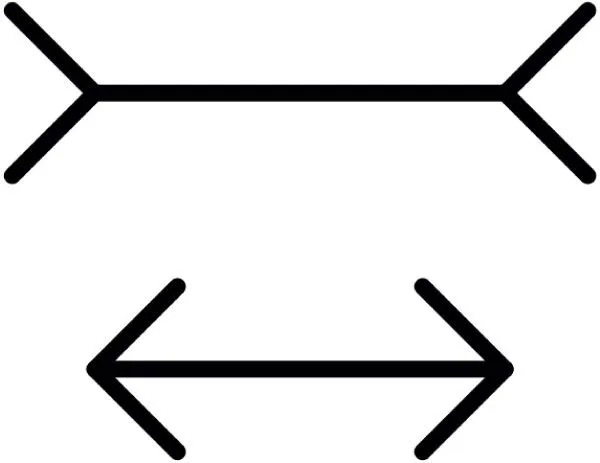
Studies show that cognitive illusions reveal how the brain takes depth and geometry from two-dimensional images using interpretive rules.
- Ambiguous illusions
These illusions can be seen in many different ways, and your brain switches between interpretations. The “old woman vs young woman” drawing would be one example. These illusions show how perception is not fixed but changes depending on what parts your brain chooses to focus on.

Why do optical illusions work?
Optical illusions work because the brain is always predicting something. It doesn’t wait for perfect information but fills in gaps, makes assumptions, and uses shortcuts to understand the world quickly. Most of the time, these shortcuts help us survive and navigate our environment. But illusions show the moments when those shortcuts don’t work.
- The Brain Uses Context
Visual perception depends on context. The same shape or colour can look completely different depending on its surroundings. This is why illusions involving contrast or brightness are so effective. They exploit the brain’s inclination to compare objects to their surroundings.
- The Brain Processes Lots of Information at Once.
Neuroscience research shows that the brain uses multiple processing streams to understand images. One handles form, another handles motion, and others handle colour or depth. These streams have strengths and weaknesses, and illusions often come up when they interact in unexpected ways.
- The Brain Fills in Missing Information
Sometimes, shapes appear even though no real lines exist. This “filling‑in” process is essential for normal vision, but it can also create illusions.
- The Brain Relies on Experience
Theories suggest that illusions happen because the brain uses past experience to interpret unclear images. When an image resembles something familiar, the brain chooses the most likely interpretation, even if it’s wrong.
Conclusion
In conclusion, illusions can help reveal how the brain works. The brain predicts elements of the image that are not always correct. Different illusions make you think about different things. Either way, next time an illusion tries to trick you, remember: it’s only your brain trying its best to comprehend the world.
Editor’s note: Our blog posts are written by young people taking part in the Youth STEMM Award. They reflect the research, ideas and understanding of the individual author.
 Jenna is from Bedford and is taking part in the Silver award. Her main interests are Economics, Biology and Maths. She is aiming to become an Investment Banker.