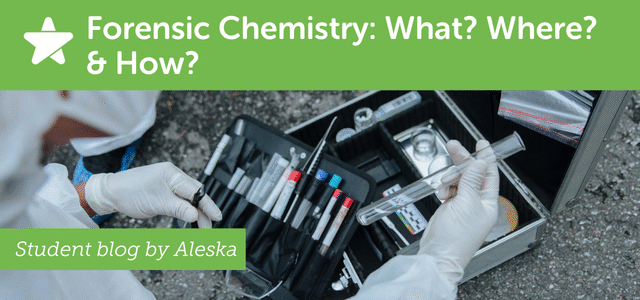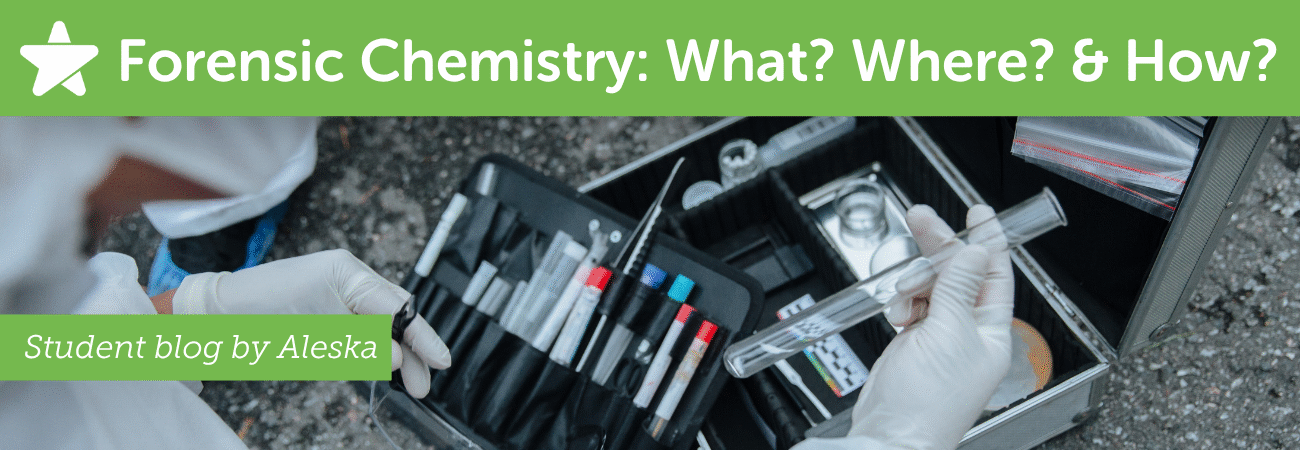
How does chemistry help solve crimes, and is forensic science really like what we see on TV? In this post, a Youth STEMM Award participant explores the fascinating world of forensic chemistry, from detecting hidden evidence to the science behind real criminal investigations.
Since the 1770s, chemistry has played an important role in the justice system, as a widely used tool to aid forensic investigations. Over 200 years later, developments in equipment and facilities have increased the efficiency with which criminal cases are investigated. So, what is forensic chemistry, how is it used, and where have you seen it?
Justice is Served
The word forensic originates from the Latin word forensis – relating to, used in, or suitable for a court of law. Any form of science used in legal investigations is forensic science.
It dates to as early as 1752, when a young woman named Mary Blandy was put on trial for poisoning her father with arsenic. The case relied heavily on the work of Dr Anthony Addington, who heated the white powder found in Mary’s belongings and tested the residue for traces of arsenic. Even though in modern times this would be considered the fundamentals, it is still widely honoured as one of the earliest uses of forensic chemistry. Other notable figures include Mathieu Orfila (1787-1853), whose work greatly contributed to contemporary ideas about toxicology, and was credited as one of the earliest people to use a microscope in assessing blood stains.
Invisible Evidence
Forensic chemistry often gives voice to silent evidence – the kind that hides in fibres and fumes until a chemist coaxes it into confession. Here I want to show appreciation to two widely used methods of analysis: chromatography and mass spectrometry. I would describe chromatography as the “sorting mechanism” of chemistry: it is all about separating complex mixtures so each chemical can be studied individually. When you were younger, I’m sure you have seen paper chromatography, but what’s truly interesting is gas chromatography (GC). First a small sample of the substance being tested is prepared. Then, a very small volume is injected into the gas chromatograph, which separates the different chemicals in the mixture, including any cutting agents (substances added to illegal drugs to increase their bulk and weight). After this, mass spectrometry comes into play (MS). Electrons are fired at the sample, which ionises it by making it lose an electron. Then the ions are sorted by their mass-to-charge ratio in the mass analyser. This combination of techniques is standard for detecting substances such as alcohol, illegal drugs and poisons in bodily fluids.
But not all chemical clues hide in liquids or powders – some survive fire, explosions and chaos.
Play with Fire
When it comes to crimes such as arson, it is difficult to differentiate between accidents and planned attacks. However, explosives usually leave behind microscopic chemical fingerprints after a blast. Even if most of the explosive burns up, tiny traces can remain on debris, metal fragments, soil, or clothing. Ion chromatography (IC) and ion mobility spectrometry (IMS) are two powerful forensic tools that help chemists analyse these tiny traces of chemicals left behind at crime scenes. Ion chromatography works by separating charged particles (like nitrates, chlorates or other explosive-related ions) so scientists can see exactly which ones are present in a sample. Meanwhile, IMS identifies chemicals by measuring how fast their ions drift through an electric field. Because different substances move at different speeds, IMS can quickly flag explosive residues or other hazardous materials. Together, these techniques allow forensic chemists to detect the smallest chemical clues that help reveal what happened during an explosion or fire.
Keep Calm and Carry On
Despite its importance in modern investigations, forensic chemistry faces several significant limitations that affect how quickly and accurately evidence can be analysed.
- Psychoactive substances: chemical compounds which alter the central nervous system. They often appear faster than laboratories can develop reference materials, which means chemists will sometimes work with incomplete data.
- Isomers: chemicals with the same molecular formula but different structures. They can be extremely difficult to distinguish using standard mass‑spectral techniques, causing potential ambiguity in results.
- High caseloads and rapid sample turnover: The overwhelming workload can increase the risk of delays.
- Chemical complexity of seized materials: mixtures of controlled substances, counterfeit medicines, or dietary supplements create interpretation challenges. This is especially difficult when legal classifications differ from country to country.
Whilst powerful, forensic chemistry must constantly adapt to new substances, evolving technologies, and increasing demands, making the field both scientifically demanding and operationally challenging.
Jackpot
It wouldn’t be fair of me to talk about how great forensic science is without showing you some cases which caught my interest.
Tennessee 2003: Edwin Jones – a criminalist – was trying to link a suspect to a murder scene where a struggle had taken place. The victim’s clothing had tiny specks of glitter embedded in the fibres. Glitter might seem useless as evidence, but forensic chemists know something surprising: different types of glitter can have distinctive chemical properties. Different brands use different combinations of plastics, dyes, metals, and reflective coatings. These chemical signatures can be compared just like paint chips or soil.
When police searched the suspect’s truck and house, they found specks of glitter. Forensic scientists analysed both samples using microscopy and chemical profiling, comparing particle size, shape and chemical composition. The glitter on the victim had matching characteristics to the glitter in the suspect’s home: a rare coincidence given how many formulations exist. This unusual evidence helped link the suspect to the crime and supported the prosecution’s timeline.
Japan 1990s: A woman was attacked late at night, and the suspect claimed he had never been near her. But the victim remembered one detail: the attacker smelled strongly of a specific floral perfume.
Chemists collected fibres from the suspect’s clothing and used gas chromatography–mass spectrometry (GC‑MS) to analyse the volatile compounds trapped in the fabric. Perfumes contain dozens of unique molecules (esters, aldehydes, terpenes) and the exact combination can act like a chemical fingerprint.
The GC‑MS results showed the fibres contained the same blend of fragrance compounds found in the victim’s broken perfume bottle at the scene.
The suspect had tried to wash his clothes, but perfume molecules cling stubbornly to fibres. Chemistry revealed what he tried to hide.
Forensic Science: Off Screen
Modern crime shows often present forensic science as fast, flawless and almost superhuman, but this creates several misconceptions about how real forensic chemistry works. Television tends to show forensic experts solving crimes in a single day, using high‑tech machines that deliver instant results. According to media researchers, this “CSI effect” makes viewers believe that forensic evidence is always available and accurate. However, chemists deal with incomplete samples, slow laboratory processes, and results that often require careful interpretation rather than dramatic certainty. Media also exaggerates the role of forensic scientists, portraying them as detectives who interview suspects and make arrests; meanwhile real forensic professionals usually work quietly in labs, analysing evidence rather than leading investigations. These dramatised portrayals make for exciting entertainment, but they can shape unrealistic expectations among the public, and even in juries who expect “CSI-level” evidence.
I hope this article served as a useful tool to expand your knowledge of the forensic world, its uses in modern-day crime analysis, and highlighted the contrast between forensics on TV and in real life. In the end, justice isn’t guesswork – it’s chemistry, patience, and the tiny clues that refuse to be ignored.
References
- Buckler, K. G. (2020). Misconceptions of forensic science fostered by media. Retrieved from https://www.ebsco.com/research-starters/communication-and-mass-media/misconceptions-forensic-science-fostered-media/
- Buckley, D. A. (2025). Mary Blandy’s fatal mistake. Retrieved from https://drangelabuckley.substack.com/p/mary-blandys-fatal-mistake
- Government, W. C.. Forensic Chemistry. Retrieved from https://www.westchestercountyny.gov/
- Sciences, A. A. (2026). What is Forensic Science? Retrieved from https://www.aafs.org/careers-forensic-science/what-forensic-science
- Simon D. Brandt, M. C. (2022). Addressing the challenges in forensic drug chemistry II. Retrieved from https://analyticalsciencejournals.onlinelibrary.wiley.com/doi/10.1002/dta.3223
- Stojanovska, N. (2013). Retrieved from Cutting Agent: https://www.sciencedirect.com/topics/medicine-and-dentistry/cutting-agent
- The Role of Gas Chromatography in Forensic Science. (2025). Retrieved from https://www.pgeneral.com/news/how-is-gas-chromatography-used-in-forensics-a-powerful-tool-for-criminal-investigation/
- Visible Proofs: Forensic Views of the Body. (n.d.). Retrieved from https://www.nlm.nih.gov/exhibition/visibleproofs/galleries/biographies/orfila.html
Editor’s note: Our blog posts are written by young people taking part in the Youth STEMM Award. They reflect the research, ideas and understanding of the individual author.
 Aleksa is a Year 13 student from Colchester. She is studying Biology, Chemistry and Maths, with a particular interest in analytical and organic chemistry.