What is it really like to spend a week working alongside scientists at a leading research institute? In this post, a Youth STEMM Award participant shares her experience of the John Innes Centre Year 10 Science Camp, from hands-on experiments to her first scientific work placement.
If you had told me from one year ago that I would be in Norwich meeting like-minded people, practising my technical skills in laboratories and completing a 2-day work placement in a prestigious institute of plant and microbial science, I would never have believed you.
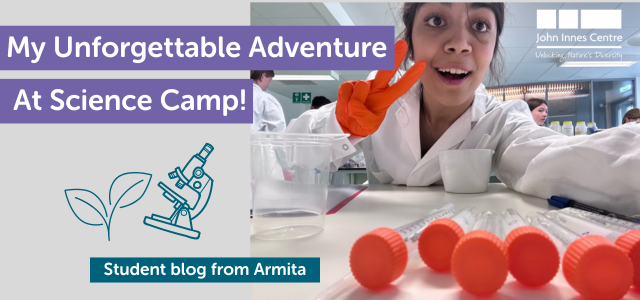
I first discovered the John Innes Centre Year 10 Science Camp through the Youth STEMM blogs as I was already enrolled in the Award. Reading about others using agar plates to grow fungi and coding a gas chromatography program motivated me to apply, even though I was almost sure that I wouldn’t be accepted. After anxiously waiting for my application to be reviewed, I ecstatically received news that I would join the 2026 cohort on a 5-day journey to experience the life of a scientist. Upon arrival at the centre, I became overwhelmed by the professional exterior of the buildings in the research park and at that moment, I knew that I was in the right place.
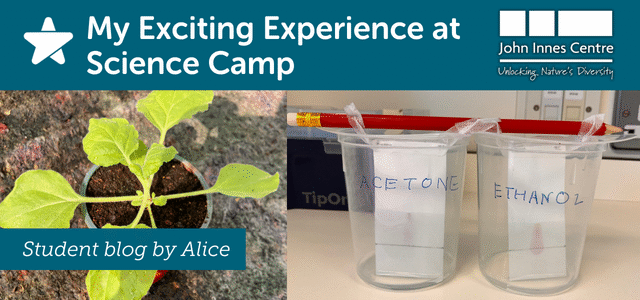
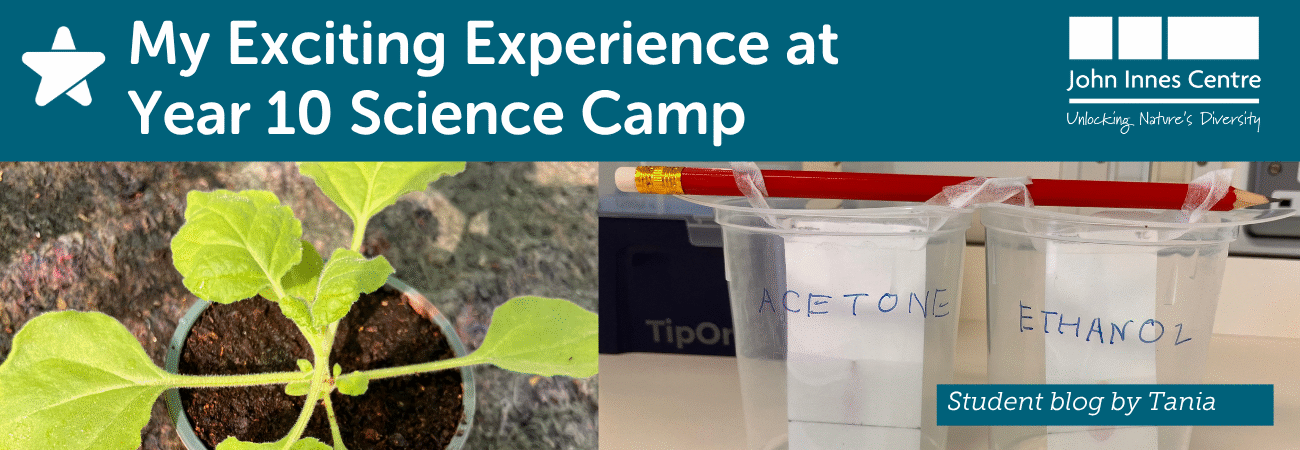
During the first two days, we were involved in a variety of hands-on practicals. Starting with a chromatography experiment using leaves and petals was an amazing way to start the day, where the separated dyes resulted in a beautiful, pastel-coloured image. Afterwards, we designed transport devices called pooters which could transfer cabbage stem flea beetles. When we inhaled through the pooter, the suction mechanism helped to trap the beetle in a small, confined space, while exhalation released the beetle into a plate for observation. Surprisingly, the struggle to make the beetles face the right way up so its gender can be properly determined helped me make friends with those who were frustrated by the same issue! Finally, we investigated how bleach concentration could affect the growth of bacteria on agar plates, which truly challenged my ability to use the micro-pipette. These opportunities helped me develop my technical skills in the wet lab and I was intrigued by all the cutting-edge technology present.
Besides the exciting experiments in the lab, we were also introduced to bioinformatics, which is a field that I have not come across before. Our professor set us up in a hypothetical scenario where a river was contaminated, and our task was to find out what human activity caused the pollution. Using BLAST (Basic Local Alignment Search Tool) to analyse DNA samples found in the river, we were able to identify the organisms (e.g. E. coli, species of planktonic algae, the common carp) which were once present in the area. It was concluded that the state of the polluted river was likely the result of untreated sewage, presence of domestic animal faeces and fertiliser runoff from nearby agricultural areas. This session made me realise how coding could help scientists investigate real life problems, like the causes of water pollution.
After the two days of carrying out experiments and exploring the different buildings within the Norwich research park, we began our two-day long work placements with scientists from the John Innes Centre. I was paired up with a post-doc who researches natural products like triterpenes. Derived from a variety of plants, these compounds have anti-inflammatory and anti-proliferative properties. Yet, triterpenes are low in abundance naturally, so a special large scale synthesis method is used to help the scientists analyse the potential of using them to create future cancer treatments.
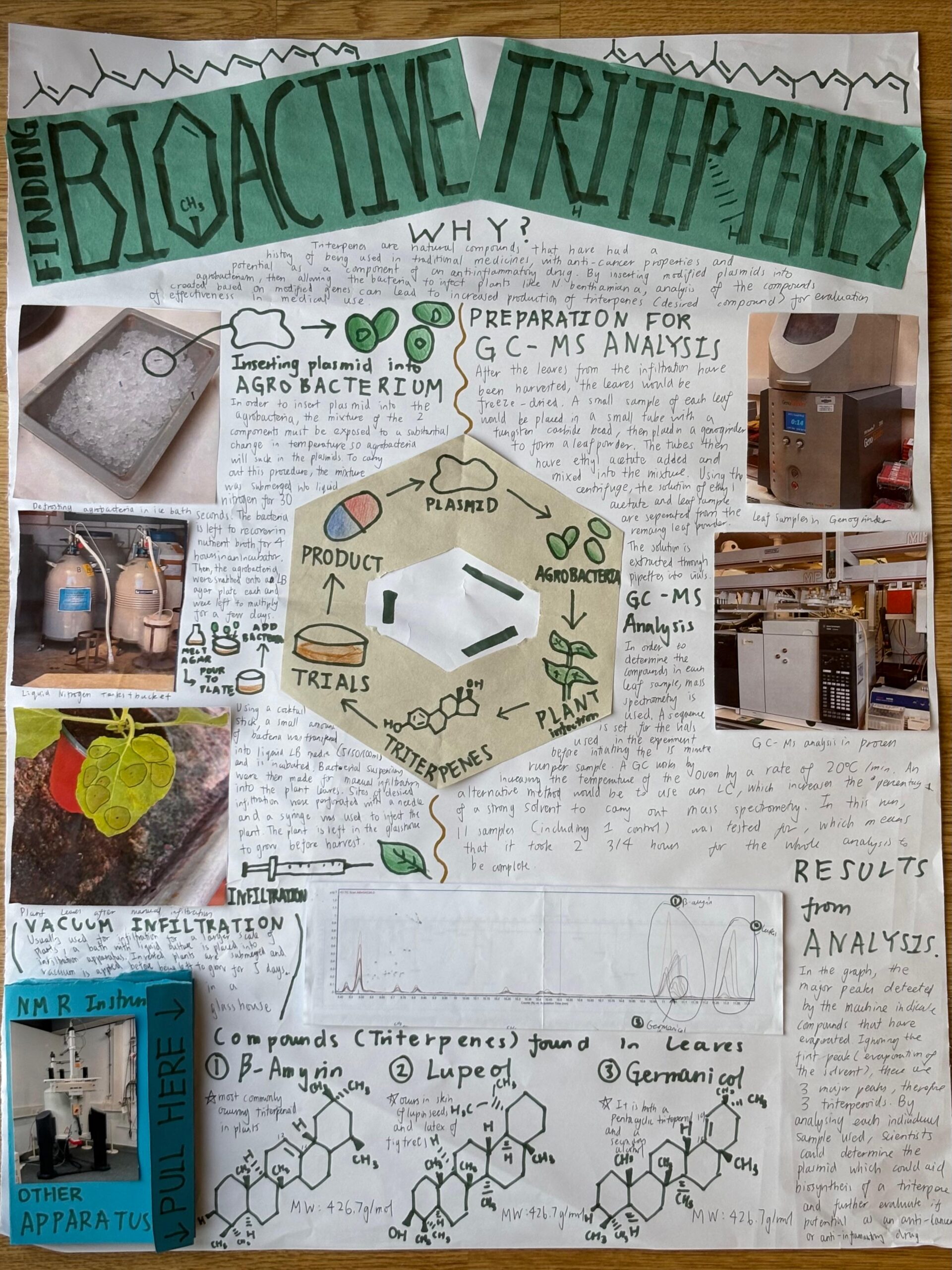
My scientific poster, made during the camp
Throughout the work experience, there were multiple highlights as I observed the day-to-day activities of a scientist:
- To move a genetically modified plasmid into some bacteria, a sudden, large temperature change was needed for higher efficiency. I was able to look at the collection of liquid nitrogen and use of it to quickly freeze the bacteria, which was exciting as I have never seen nitrogen at such low temperatures before!
- I was also exposed to a variety of professional equipment like the gas chromatography-mass spectrometry machine, which carries out mass spectrometry. After the machine analysed the leaf extract samples, I was taught how to interpret the mass spectrum produced after chromatography and tried to identify the three common compounds in each graph that represents the chemical composition of the extract.
- Going to the glasshouse was also a highlight as I could see where bacteria could be infiltrated into the plants via vacuum or manual methods. During my placement, I used the manual method and injected a buffer into the plant using a syringe, which would be left to grow and made into a leaf extract after a few weeks.
The work placement has undoubtedly helped me understand the qualities needed to become a scientist like problem-solving (when we found a way to open a freezer door frozen shut with ice) and has deepened my interest in plant science.
On the final day, we were tasked with making and presenting a scientific poster to summarise our work placement. To help us do so, we were advised by a group of PhD students, who kindly showed us some posters they had previously designed, on how to organise the information we had gathered. After spending plenty of time crafting the poster, I explained the research topic I explored during my placement to some parents and gained insight from senior scientists on careers I could potentially pursue around the topic I was presenting. Overall, it was a fruitful experience to learn about the importance of communication in the scientific world full of jargon, with and aid from people who are working in similar areas.
To find out about work experience opportunities at the John Innes Centre visit: https:www.jic.ac.uk/training-careers/work-experience/
Please note: Our blog posts are written by young people taking part in the Youth STEMM Award. They reflect the research, ideas and understanding of the individual author.
 Yat To (Tania) is a Year 11 student from Brighton who is taking part in the Silver Award. Her interests are Biology, Chemistry and Maths and she hopes to work in biotechnology in the future.